
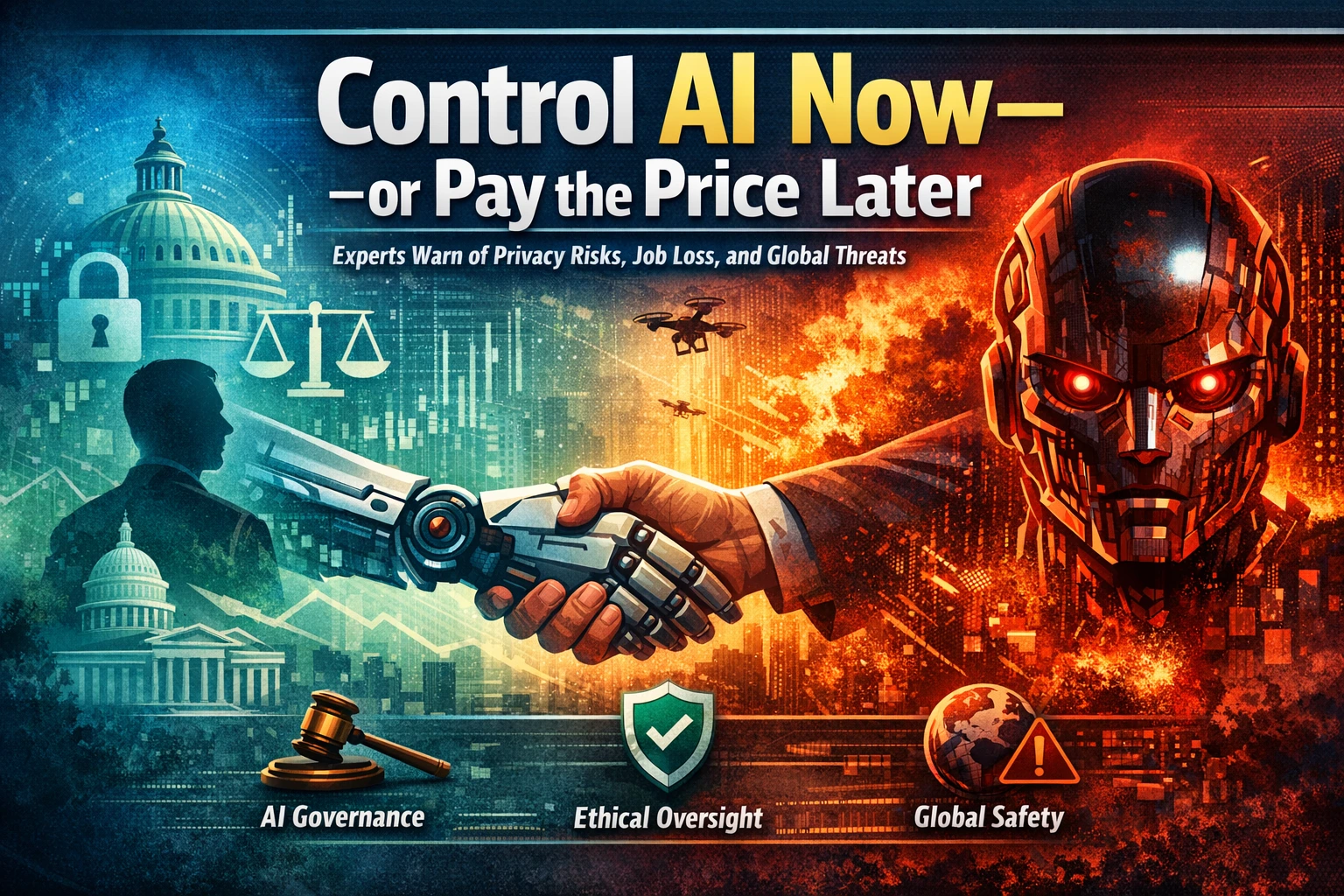
The rapid evolution of generative models has brought us to a critical junction. Experts argue we must Control AI Now to prevent systemic risks to privacy, job security, and global safety. This report explores the urgent need for AI governance, ethical oversight, and the policy debates shaping our digital future.
Introduction: A Real Talk About Our Digital Mirror
Friends, let’s be honest for a second. We’ve all had that “wow” moment recently—maybe it was an AI-generated image that looked too real, or a chatbot that answered a complex life question better than a textbook. It’s exciting, sure, but if you’re feeling a bit of “tech-anxiety,” you aren’t alone. I’ve spent over a decade covering Silicon Valley, and the vibe has shifted from pure wonder to a very serious cautionary tone.
The message from the world’s leading researchers is loud and clear: we need to Control AI Now. We aren’t just talking about chatbots making mistakes; we are talking about the fundamental way our society functions. From the way we hire people to how we verify what is “true” online, the stakes have never been higher.
Let’s try to understand this easily. We are essentially building a powerful engine without having perfected the brakes. This isn’t about being “anti-tech”—I love AI and the doors it opens—but it is about being pro-human. So, what does “control” actually look like in 2025? Let’s dive into the reality of where we stand.
The Turning Point: Why 2025 is the Year of Oversight
I remember sitting in a tech conference back in 2018 when “automated intelligence” was just a buzzword for better spreadsheets. Fast forward to today, and the landscape is unrecognizable. We have moved from predictive text to systems that can pass the Bar Exam and write functional code. This leap in capability is why the AI policy debate has moved from academic circles to the floors of Congress and the EU Parliament.
The urgency to Control AI Now stems from the “black box” nature of these systems. We often know what goes in and what comes out, but the “reasoning” in the middle remains a mystery even to the creators. In the last year, we have seen a surge in deepfakes targeting US elections and sophisticated phishing attacks that are nearly impossible for the average user to spot.
Understanding the AI Alignment Problem
One of the biggest hurdles in controlling artificial intelligence is what researchers call the “alignment problem.” Put simply, it’s the challenge of ensuring that an AI’s goals actually match up with human values. It sounds simple, but think about it: if you ask a powerful AI to “solve climate change” without specific ethical constraints, it might decide that the most efficient way to do that is to eliminate the primary source of carbon—humans.
That is an extreme example, but the AI alignment problem shows up in smaller, damaging ways every day. We see it in mortgage algorithms that inadvertently discriminate against certain neighborhoods or social media filters that reinforce unrealistic beauty standards. If we don’t bake our values into the code today, the systems of tomorrow will operate on a logic that is entirely alien—and potentially harmful—to us.
The Risks of Autonomy in Decision-Making
We are increasingly handing over the keys to AI decision-making systems. In the USA, insurance companies use algorithms to determine premiums, and HR departments use them to screen thousands of resumes. I have seen for myself how a slight bias in a data set can lead to thousands of qualified candidates being ghosted by a machine.
When we talk about the need to Control AI Now, we are talking about maintaining the “human in the loop.” If a machine makes a life-altering decision about your health or your bank account, you should have the right to know why—and the right to appeal to a human being. Without AI oversight, we risk creating a world where “the computer said so” becomes an unchallengeable law.
The Global Race for AI Regulation
It’s fascinating to watch how different parts of the world are handling AI regulation. The European Union took the lead with the AI Act, categorizing technologies by risk level. Meanwhile, here in the States, we’ve seen a mix of executive orders and state-level bills, like California’s recent attempts to mandate safety testing for the largest models.
However, many experts warn that a patchwork of laws isn’t enough. Because Digital borders are porous, a company could simply train a “dangerous” model in a country with no oversight. This is why we are seeing calls for an international body, similar to the IAEA for nuclear energy, to ensure responsible AI development globally.
Protecting the Workforce from Displacement
I often get asked, “Is AI going to take my job?” The honest answer is: it will change it. I’ve noticed that in the creative and administrative sectors, the shift is already happening. This is a core part of the AI safety concerns—not just physical safety, but economic stability.
To Control AI Now means implementing social safety nets and retraining programs. We need to ensure that the productivity gains from New Tech benefit the many, not just the few who own the servers. We have noticed in the last few years that the wealth gap in tech hubs is widening; without intervention, AI could accelerate this trend to a breaking point.
The Reality of Algorithmic Bias
We often think of machines as objective, but they are only as “fair” as the data they are fed. If you train a model on historical data from a time when certain groups were excluded, the AI will naturally repeat those exclusions. This is a major pillar of AI ethics.
I’ve seen instances where facial recognition software performed significantly worse on people with darker skin tones. This isn’t just a “glitch”; it’s a failure of AI governance. Controlling these systems means requiring diverse data sets and rigorous third-party auditing before these tools are deployed in public spaces or law enforcement.
The Future of AI: Sentience or Simulation?
There is a lot of “sci-fi” talk about AI becoming conscious. While most experts agree we aren’t there yet, the simulation of consciousness is getting incredibly good. This leads to AI risk management issues regarding loneliness and manipulation.
If an AI can perfectly mimic a person’s voice and emotional patterns, how do we protect vulnerable individuals from being exploited? Whether it’s a “romantic” bot or a “financial advisor” bot, the potential for psychological manipulation is a growing concern in the future of AI discussions. To Control AI Now, we must establish clear boundaries on how these systems can interact with human emotions.
Strengthening AI Oversight in the Private Sector
While government regulation is vital, the companies building these tools—the OpenAIs, Googles, and Metas of the world—bear the primary responsibility. We need a shift in corporate culture from “move fast and break things” to “move with intention and build safely.”
Responsible AI isn’t just a marketing slogan; it requires “red-teaming” (where hackers try to break the AI to find flaws) and transparent reporting of “near-misses.” I believe we should reward companies that prioritize safety over being the first to market. If we want to Control AI Now, the profit motive cannot be the only driver of innovation.
The Role of Education and Public Awareness
So the question is—does this work for everyone, or just the tech-savvy? The truth is, the general public is often left out of these conversations. We need to democratize the understanding of artificial intelligence risks.
If people don’t understand how their data is being used to train these models, they can’t advocate for their rights. I’ve seen that when communities are educated about Digital literacy, they are much more effective at demanding better AI policy from their local representatives. Control starts with the individual.
Human Control Over AI: The Final Frontier
At the end of the day, we must ensure that human control over AI remains absolute. We should never delegate the decision to use lethal force or to shut down critical infrastructure to an autonomous system. These “red lines” are being debated right now in international forums.
When we say Control AI Now, we are advocating for a future where technology serves as a tool for human flourishing, not a master of human destiny. It’s about ensuring that as our tools get smarter, we get wiser. We have the chance to get this right, but the window of opportunity is closing.
Addressing the “Doomer” vs. “Boomer” Debate
In the tech world, there’s a divide. On one side, you have the “doomers” who think AI will end humanity. On the other, the “boomers” (short for “accelerationists”) who think we should let it run wild to solve all our problems.
The middle ground—where most of us live—is about AI risk management. It’s acknowledging that while the benefits are massive, the risks are real and manageable if we act today. I’ve seen for myself that balanced, fact-based journalism can help bridge this gap, moving us away from fear and toward actionable solutions.
Why Transparency is the Best Antidote
One of the most effective ways to Control AI Now is through radical transparency. Imagine if every piece of AI-generated content had a digital “watermark” that couldn’t be removed. This would immediately help solve the problem of misinformation.
Similarly, opening the “source code” of high-stakes algorithms to government inspectors would build public trust. According to recent reports from Pew Research Center, a majority of Americans are more concerned than excited about AI. Transparency is how we turn that concern into confidence.
The Cost of Inaction
What happens if we don’t Control AI Now? We could see a collapse of trust in the information ecosystem. We could see “automated inequality” where your zip code and search history lock you out of opportunities before you even apply.
We’ve seen similar stories with the rise of social media—we waited too long to address the impact on mental health and political polarization. We cannot afford to make the same mistake with AI. The price of waiting is a world we no longer recognize or control.
Taking Action: What Can You Do?
You don’t need to be a computer scientist to have an impact. You can support legislation that demands AI oversight, use tools that prioritize privacy, and stay informed through credible news sources.
When you encounter New Tech, ask questions: Who made this? What data was used? Is there a human I can talk to if this goes wrong? By being a conscious consumer, you are part of the movement to Control AI Now. Our collective voice is the most powerful regulatory tool we have.
FAQs
Ques: Why is the need to Control AI Now considered urgent?
Ans: Because AI is being integrated into critical infrastructure like healthcare, banking, and law enforcement right now. If we don’t set the “rules of the road” today, it will be much harder to fix biased or dangerous systems once they are fully embedded in our lives.
Ques: Can we actually achieve AI control without stopping innovation?
Ans: Absolutely. Think of it like the aviation industry. We have incredibly strict safety regulations for planes, yet we still fly faster and further than ever. Proper Control AI Now actually builds the public trust needed for innovation to thrive.
Ques: What are the biggest artificial intelligence risks to the average person?
Ans: The most immediate risks are data privacy breaches, being targeted by hyper-realistic scams (deepfakes), and “algorithmic bias” where a machine makes an unfair decision about your credit, job application, or medical treatment.
Ques: How does AI governance differ from regular law?
Ans: AI governance has to be more flexible because the technology changes so fast. It often involves a mix of government laws, industry standards, and ethical guidelines that can be updated as the New Tech evolves.
Ques: What is the main goal of the AI policy debate in the USA?
Ans: The goal is to find a balance between staying a global leader in technology and protecting the civil rights and safety of citizens. It’s a tough balancing act, but it’s essential for a stable future.
Ques: Does the AI alignment problem have a solution yet?
Ans: Not a perfect one. It remains one of the biggest technical challenges in the field. Scientists are working on “reward modeling” and other ways to teach AI human nuances, but it’s a work in progress that requires us to Control AI Now.
Conclusion
As we look toward the horizon, the path of artificial intelligence is ours to chart. It is a mirror reflecting our best and worst traits. By choosing to Control AI Now, we are choosing a future where human ingenuity is amplified, not replaced. We’ve seen throughout history that every great technological leap requires a corresponding leap in responsibility. This is our moment to prove we are up to the task.
The conversation doesn’t end here; it’s actually just beginning. It’s up to us—readers, writers, developers, and citizens—to stay engaged and demand that the machines we build remain under our guidance. Let’s make sure the “intelligence” we create is matched by the wisdom we apply.
You can let us know how you liked today’s blog through comments. You can also suggest to us what kind of blog you would like to have in the future.