
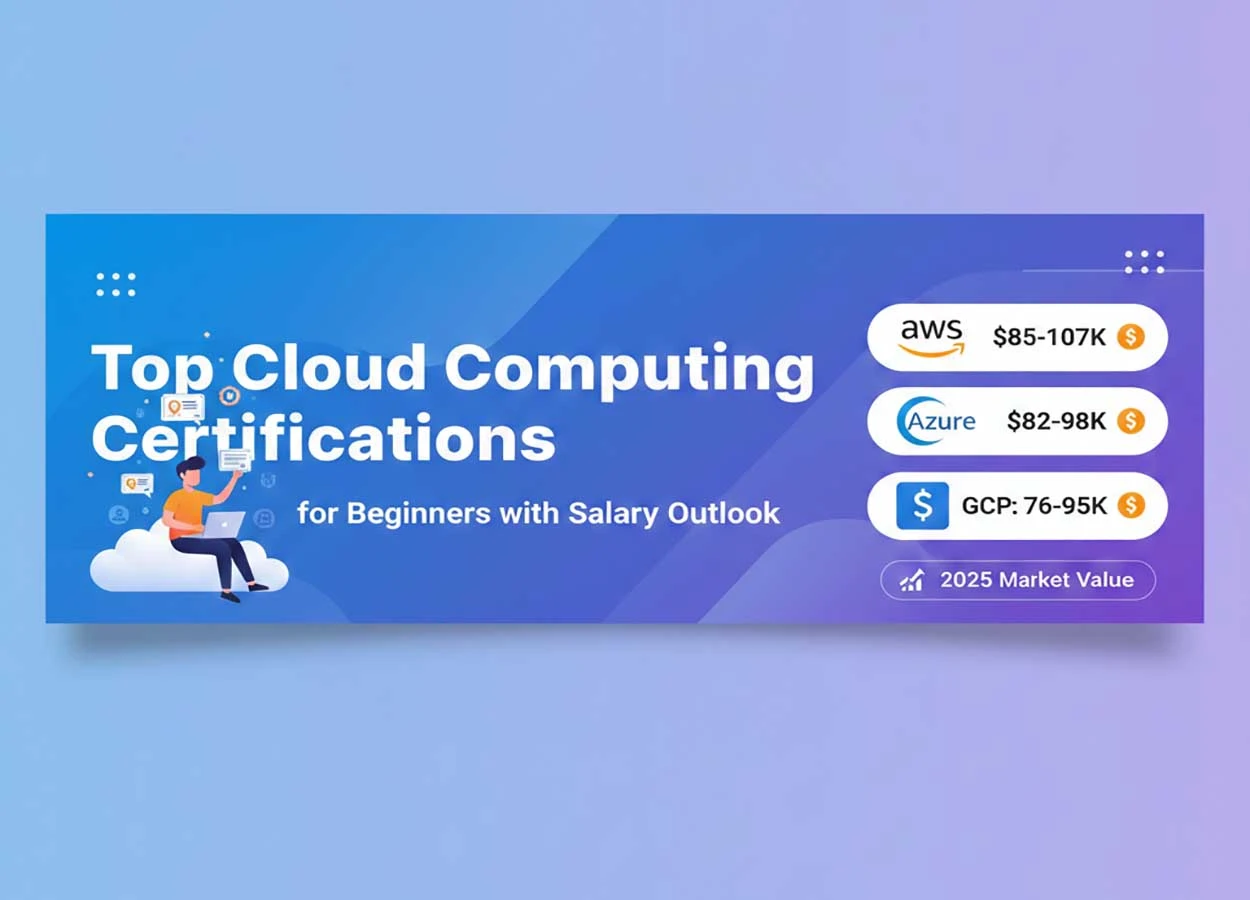
Breaking down the Top cloud computing certifications for 2025. This guide explores the best entry-level options from AWS, Azure, and Google, alongside detailed salary expectations for newcomers. Whether you’re switching careers or starting fresh, we analyze the current market value and career trajectory of each path in the USA tech industry.
Introduction
Friends, if you have spent any time looking at job boards lately, you have probably noticed a massive shift. I have seen it myself over the last decade: the traditional IT role is fading, replaced by a world that lives almost entirely in the “cloud.” You might be asking, “Where do I even start?” or “Is it worth the money?” Let’s try to understand it easily.
The good news is that the barrier to entry is lower than ever, provided you have the right roadmap. Choosing the Top cloud computing certifications is not just about adding a digital badge to your LinkedIn; it’s about proving to a hiring manager in Austin or Seattle that you understand the modern plumbing of the internet. In this blog, we’ll dive into the best certifications for beginners and, most importantly, the actual salary numbers you can expect in 2025.
The 2025 Cloud Reality: Why Now?
We have noticed in the last few years that “The Cloud” is no longer a buzzword; it is the default state of technology. From small startups to massive government agencies, everyone is migrating away from physical servers. This shift has created a massive skills gap. I often talk to recruiters who tell me they have the budget for new hires but can’t find people who know the difference between an S3 bucket and a Blob storage account.
For a beginner, this is a golden opportunity. You don’t necessarily need a four-year Computer Science degree to get your foot in the door anymore. What you do need is a recognized credential that speaks the language of the big three providers: Amazon, Microsoft, and Google. This is why looking into the Top cloud computing certifications is the single best move you can make for your career right now.
AWS Certified Cloud Practitioner: The Gold Standard for Starters
If you are looking for the most recognized entry point, the AWS Certified Cloud Practitioner (CLF-C02) is hard to beat. Amazon Web Services still holds the lion’s share of the market. I’ve seen for myself how often “AWS knowledge” appears as a requirement in job descriptions, even for non-technical roles like sales or project management.
This certification covers the basics: what the cloud is, how it’s billed, and the core services like EC2 (computing) and S3 (storage). It is designed specifically as one of the cloud computing certifications for beginners. It doesn’t require deep coding skills, making it perfect for someone coming from a completely different industry.
Breaking Down the Entry-Level Cloud Certification Salary for AWS
Let’s talk money, because that’s why we’re here. According to recent 2025 data, an Entry-level cloud certification salary for someone holding the AWS Cloud Practitioner cert typically ranges from $85,000 to $107,000 in the United States.
Now, keep in mind, if you’re in a high-cost area like San Francisco or New York, those numbers can lean toward the $110,000 mark. Even in mid-market cities, starting at $90k with just one foundational cert and some “home lab” experience is a reality I’ve seen many career-changers achieve. It’s a high-ROI move considering the exam only costs $100.
Microsoft Certified: Azure Fundamentals (AZ-900)
While AWS is the giant, Microsoft Azure is the “corporate darling.” If you want to work for a Fortune 500 company or a government contractor, Azure is likely what they are using. The AZ-900 exam is Microsoft’s answer to the Top cloud computing certifications for newcomers.
We have seen a huge uptick in Azure adoption because it integrates so well with the Microsoft software most companies already use (like Office 365 and Windows). The AZ-900 is often considered one of the best cloud certifications for entry-level candidates because it is very approachable. You’ll learn about “Cloud Concepts,” “Azure Architecture and Services,” and “Azure Management and Governance.”
Azure Salary Outlook: What to Expect in Your First Year
The Cloud computing certification salary for an Azure Fundamentals holder is surprisingly competitive. In many regions, it mirrors AWS, with average starting salaries sitting around $82,000 to $98,000. However, I’ve noticed that if you combine this with a basic understanding of cybersecurity, the floor often jumps to $105,000.
Microsoft frequently offers “Cloud Skill Challenges” where you can actually get a voucher to take this exam for free. This makes it an incredibly low-risk way to pivot your career into the Digital space without breaking the bank.
Google Cloud Digital Leader: The Rising Star
Google Cloud Platform (GCP) might be in third place for market share, but don’t count them out. They are the leaders in data analytics and AI infrastructure. The Google Cloud Digital Leader is their foundational cert. It’s designed for anyone who wants to demonstrate knowledge of Google Cloud’s core products and how they solve business problems.
[Image comparing AWS, Azure, and Google Cloud market shares in 2025]
I’ve seen a trend lately where startups, especially those in the “New Tech” and AI sectors, prefer Google Cloud. It’s perceived as more “developer-friendly.” If you’re eyeing a role in a fast-paced, innovative environment, this is definitely one of the Top cloud computing certifications to consider.
GCP Salary Realities: Is it the Highest Paying?
Interestingly, because there are fewer GCP-certified professionals compared to AWS, the demand-to-supply ratio can sometimes drive salaries higher. A Cloud computing certification salary for a Google Cloud Digital Leader typically averages between $76,000 and $95,000.
While the “Digital Leader” cert is more business-oriented, it sets you up perfectly for the Associate Cloud Engineer exam, where the real money ($120k+) starts. It’s a strategic first step in a very lucrative ecosystem.
CompTIA Cloud+: The Vendor-Neutral Alternative
Sometimes, you don’t want to tie yourself to just one provider. That’s where CompTIA Cloud+ comes in. Unlike the “Big Three” certifications, Cloud+ is vendor-neutral. This means it teaches you the underlying principles of cloud computing that apply to any platform.
This is a fantastic option for cloud certification courses beginner students who want a broad foundation. It covers cloud architecture, security, and maintenance in a way that makes you a “Swiss Army Knife” for an IT department. In my experience, smaller managed service providers (MSPs) love seeing CompTIA certs because their clients often use a mix of different cloud tools.
CompTIA Cloud+ Salary and Market Value
The salary for Cloud+ holders in the USA is quite robust, often averaging around $80,000 to $113,000. It’s a bit more “technical” than the “Fundamentals” certs from Amazon or Microsoft, which is reflected in the slightly higher median pay. If you already have a bit of IT experience—maybe you’ve worked help desk or done some basic networking—this is one of the Top cloud computing certifications to help you level up quickly.
How to Choose: Which One is Right for You?
So the question is—does this work for everyone? Not necessarily. The “best” certification depends on where you want to work. I always tell my readers to do a quick experiment: go to LinkedIn or Indeed, type in your city and the word “Cloud,” and see which provider pops up most often.
Go AWS if you want the most job openings and a massive community.
Go Azure if you want to work in big corporate environments or government.
Go GCP if you love data, AI, and startup culture.
Go CompTIA if you want to be a generalist and keep your options open.
No matter which you choose, these are all Top cloud computing certifications that can drastically change your financial future.
The “Catch-22” of Experience vs. Certification
I hear this all the time: “I have the certification, but no one will hire me without experience!” I’ve seen for myself that this is the biggest hurdle for beginners. Here is the secret—you have to create your own experience.
Don’t just pass the exam. Build a website on S3, set up a virtual machine on Azure to host a simple app, or use Google Cloud’s free tier to run a basic data analysis project. When you can show a recruiter a GitHub repository or a personal portfolio, that Entry-level cloud certification salary becomes much easier to negotiate.
The Growing Influence of AI on Cloud Careers
In 2025, you cannot talk about the cloud without talking about AI. Every major cloud provider is currently dumping billions into “AI clouds.” This is actually great news for beginners. If you get a foundational cloud cert now and then take a short follow-up course on how to use AI tools within that cloud (like AWS Bedrock or Azure OpenAI), you become exponentially more valuable.
We have noticed that job titles are shifting. Instead of just “Cloud Engineer,” we are seeing “Cloud & AI Associate.” The infrastructure—the cloud—is the “engine,” and AI is the “fuel.” By mastering the Top cloud computing certifications, you are essentially learning how to build and maintain the engine of the future.
Studying for Success: My Personal Tips
Over the years, I have seen students spend hundreds on boot camps they didn’t need. For beginner-level certs, you can often pass using free or low-cost resources.
- Free Tiers: All major providers offer a free tier. Use it!
- Official Training: AWS Skill Builder, Microsoft Learn, and Google Cloud Skills Boost are excellent and often free.
- Community: Join Reddit or Discord groups. The “Cloud Newbie” community is incredibly supportive.
Looking for cloud certification courses beginner friendly? Start with the official documentation before buying expensive third-party materials.
Geography Matters: Where the Jobs Are
While remote work is still a thing, being near a tech hub can still boost your Entry-level cloud certification salary. We’ve seen that cities like Charlotte (FinTech), Nashville (Healthcare), and Salt Lake City (Silicon Slopes) are seeing a massive surge in cloud jobs that pay just as well as Silicon Valley but with a much lower cost of living.
Even if you aren’t in those cities, the skills you gain from the Top cloud computing certifications are globally transferable. It’s one of the few careers where your “office” can truly be anywhere with a decent Wi-Fi connection.
Is the Investment Worth It?
Let’s look at the math. A certification exam typically costs between $100 and $200. Study materials might cost you another $50. In total, you’re looking at a $250 investment. Compare that to the potential jump from a $45k non-tech job to an $85k+ Cloud computing certification salary. That is a life-changing return on investment (ROI).
I have spoken with single parents, former retail workers, and even former teachers who made this jump in less than six months. It takes discipline, but the path is well-defined.
Final Thoughts on Starting Your Journey
The “perfect” time to start doesn’t exist. Technology moves fast, and there will always be a new tool to learn. But the foundational concepts—security, networking, and resource management—remain the same. By focusing on the Top cloud computing certifications, you are building a bedrock of knowledge that will last you for the rest of your career.
The New Tech world is waiting for you. Don’t let the technical jargon scare you off. We all started somewhere, and most of us started exactly where you are now: wondering which button to click first.
FAQ: Common Questions About Cloud Certifications
Ques: Are Top cloud computing certifications enough to get a job with no degree?
Ans: Yes, absolutely. While a degree helps, the cloud industry is very “skills-first.” I have seen many people secure high-paying roles simply by having 2-3 certs and a solid portfolio of hands-on projects.
Ques: Which of the Top cloud computing certifications is the easiest for a non-tech person?
Ans: Generally, the Microsoft Certified: Azure Fundamentals (AZ-900) is considered the most beginner-friendly due to its focus on conceptual understanding rather than deep technical configuration.
Ques: How long does it take to study for Top cloud computing certifications?
Ans: For a foundational exam like the AWS Cloud Practitioner, most people spend about 20 to 40 hours of focused study. You can easily achieve this in a month by studying an hour or two a day.
Ques: What is the highest Entry-level cloud certification salary I can expect?
Ans: If you live in a high-demand tech hub like San Francisco or Seattle, it’s not uncommon for an entry-level professional with an Associate-level cert to start at $110,000 to $125,000.
Ques: Do Top cloud computing certifications expire?
Ans: Yes, most cloud certifications are valid for 2-3 years. The industry moves fast, so providers want to ensure your skills are up to date. Renewing them usually involves taking a shortened version of the exam or earning continuing education credits.
Conclusion
Stepping into the world of cloud computing can feel like learning a new language, but it is a language that the entire world is now speaking. Whether you choose AWS, Azure, or Google, you are making a commitment to your future self. I’ve watched this industry evolve for over a decade, and I can tell you: the demand for cloud talent isn’t slowing down—it’s accelerating.
Which path are you leaning toward? Are you team Amazon, team Microsoft, or team Google? Or perhaps you’re looking for a vendor-neutral start?
You can let us know how you liked today’s blog through comments. You can also suggest to us what kind of blog you would like to have in the future.